Proximity is now SPA Australia LEARN MORE



With major Defence investments planned for the years ahead, ensuring that these investments translate into positive outcomes will be critical. Anthony Ween from SPA Australia explain how better problem definition, stronger decision-making and systems thinking can help Defence improve outcomes and reduce risk.

When complex Defence programs encounter challenges, the conversation often focuses on what went wrong during delivery, whether that be delays, changing requirements, cost pressures or capability gaps. But many of these issues can be traced back much earlier, before implementation begins, to whether organisations have clearly defined the problem they are trying to solve.
In many cases, organisations can invest significant time, money and expertise into addressing the wrong problem despite the commitment, capability and good intentions of the people involved.
A structured approach to problem-solving can make a huge difference to the outcomes of complex programs. When organisations take the time up front to fully understand the problem, test assumptions, engage the right stakeholders and establish clear measures of success, they are better positioned to make effective decisions and deliver meaningful outcomes.
In Defence, the ability to understand the problem earlier, test choices clearly and make better decisions faster is a source of decision advantage.
This is particularly important in Defence, where decisions are influenced by a range of interconnected factors, including operational requirements, workforce capability, technology, industry capacity, strategic priorities and changing environments.
This is especially relevant as Defence implements the 2026 National Defence Strategy and the Rebuilding Defence Capability reforms. These reforms emphasise faster delivery, clearer accountabilities, stronger assurance and more disciplined decision-making. The aim is to help Defence deliver the right capability to the warfighter, on time, on budget and with real effect.
Why complex programs struggles
Across major government programs, including findings from Australian National Audit Office (ANAO) reports and other public reviews, similar themes emerge. While every program has its own unique circumstances, recurring challenges include unclear problem definitions, weak upfront planning, untested assumptions and insufficient measures to determine whether intended outcomes are being achieved.
By the time this becomes clear, organisations may have already committed substantial resources and created momentum around an approach that does not fully address the original challenge. A clear problem definition provides the foundation for effective decision-making throughout the life of a program.
The value of slowing down to move faster
In government, there is often pressure to move quickly from identifying an issue to developing a solution. However, investing more time upfront can ultimately accelerate progress.
A structured approach begins with asking fundamental questions: What decision are we trying to support? What problem are we trying to solve? What evidence do we have? What assumptions are we relying on? Who needs to be involved to properly understand the challenge?
These questions can sometimes feel like they delay action, but they help prevent costly rework and ensure effort is focused on the right priorities.
Creating better decision-making environments
Experience and judgement are critical in Defence decision-making; however, complex challenges cannot be solved through instinct alone. The strongest decisions combine experience with evidence, analysis and diverse perspectives. This requires creating environments where assumptions can be challenged and where people feel confident raising concerns or presenting alternative views.
Decision advantage also depends on workforce capability. People need the technical skills, confidence and permission to ask better questions, test assumptions and use evidence well. This includes drawing on strategic, operational, technical, commercial, policy, industry and analytical expertise early.
Constructive challenging is one of the mechanisms that helps organisations identify risks early and make better decisions.
Successful programs also ensure decision-makers have access to reliable information as programs evolve. Sometimes new information emerges, circumstances change and assumptions that were reasonable at the beginning may need to be revisited. The ability to pause, reassess and adjust course is a sign of mature decision-making.
Why systems thinking matters
Systems thinking provides a valuable framework for navigating complex challenges by recognising that no major Defence initiative exists in isolation. A decision in one area can have consequences across the broader system.
Taking a systems approach helps decision-makers understand these connections, consider unintended consequences and develop solutions that account for the wider environment. It also supports more integrated Defence outcomes by bringing together operational, workforce, technology, industry, commercial and policy perspectives.
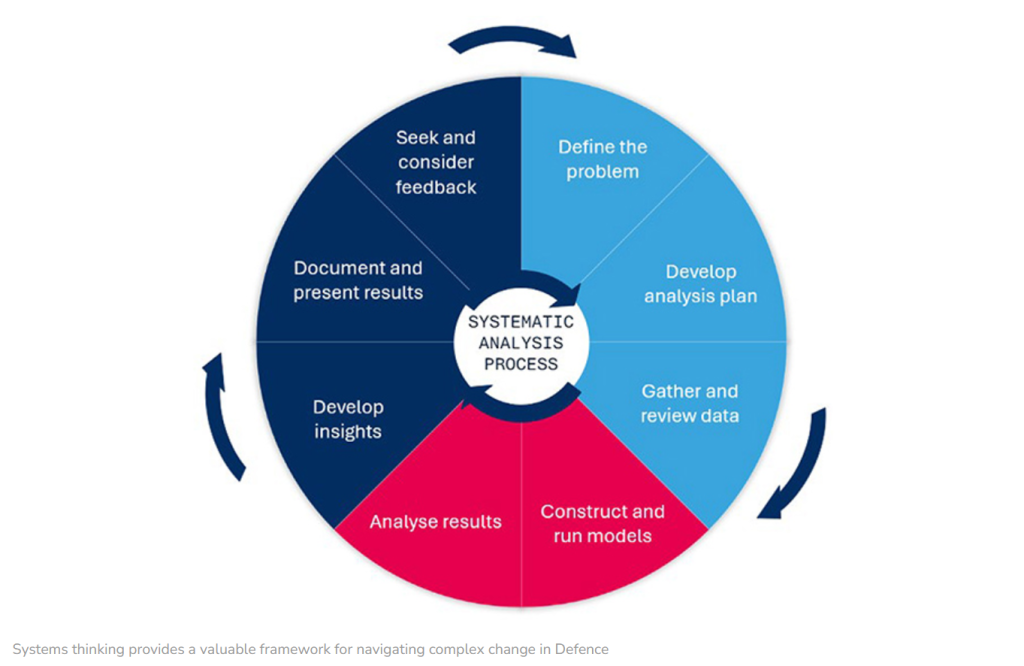
Complex problems require input from people with different experiences, expertise and viewpoints because no single team sees the whole system on its own.
Better questions lead to better outcomes
The future success of complex Defence initiatives will depend on the quality of the decisions made along the way. The most important question at the beginning of any major initiative is not simply, “How do we deliver this?” It is, “Are we solving the right problem?”
By investing time upfront, challenging assumptions and applying a structured approach to problem-solving, Defence organisations can improve decisions and reduce risk. Asking “Are we solving the right problem?” up front will support Defence to provide the right capability and deliver outcomes that better support Australia’s strategic objectives.
Published on consultancy.com.au in August 2026
About SPA Australia
SPA Australia (Systems Planning & Analysis, Australia) is a leading provider of integrated legal, commercial, consulting and analytics services to government.
Our multidisciplinary approach, trusted advice and leading-edge technology and analysis help clients deliver measurable outcomes.
In 2025, SPA Australia acquired Proximity, a highly regarded professional services firm specialising in government legal, consulting, and commercial advisory services.
Our parent company, SPA, has more than 3,000 employees in 30 locations within the US, UK and Australia. In Australia, more than 130 employees are based across Canberra, Melbourne, Sydney and Adelaide, where our local teams deliver sovereign capability backed by global expertise.